
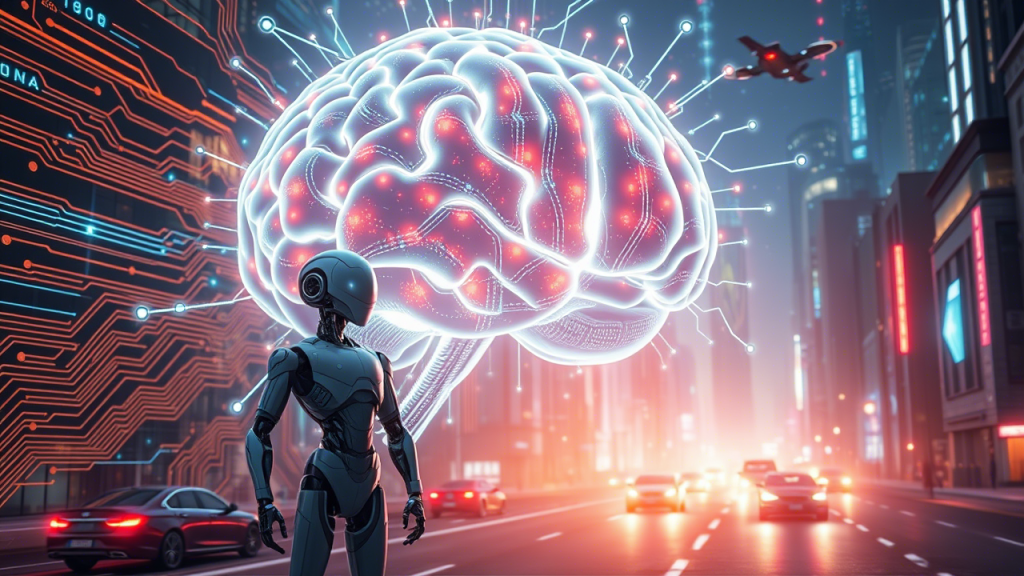
Artificial Intelligence has already transformed our lives in many ways. From recommending music on Spotify to self-driving cars, AI is no longer just a futuristic concept. But what if I told you we’re on the brink of something much bigger? Enter AGI (Artificial General Intelligence) and its even more powerful cousin, ASI (Artificial Superintelligence).
These two stages of AI aren’t just upgrades—they’re the next leap in human evolution. And, perhaps, they’re the last invention humanity will ever need to make.
What is AGI?
AGI is the holy grail of artificial intelligence. Unlike today’s narrow AI, which excels at specific tasks (think Siri or Google Translate), AGI would be capable of doing anything a human can do. Picture an AI that can read a textbook, understand it, apply the knowledge, and even improve upon it. It could write software, design cars, compose symphonies, and solve complex scientific problems. In short, an AGI could function as a human brain, but faster, more efficiently, and tireless.
This is where things get exciting. Once we build AGI, it will have the potential to improve itself, creating smarter versions of itself. This means, theoretically, an AGI could continue evolving without human intervention, getting smarter by the second.
And then there’s ASI…
But AGI is just the beginning. What happens when we push intelligence beyond human limits? Enter ASI—Artificial Superintelligence.
Imagine an AI so advanced, it surpasses the smartest human minds in every single field. Think of an ASI being able to:
Solve the world’s most complex scientific puzzles in minutes. Cure diseases or end hunger with algorithms. Create technologies and concepts that we can’t even comprehend today. Predict the future with unimaginable accuracy.
If AGI is like a highly advanced human brain, ASI is more like a super-brain that not only outsmarts humans but does so on a scale that’s nearly incomprehensible. It’s like trying to understand the thoughts of someone who has billions of years of processing power in just a second.
Why is AGI Humanity’s Last Invention?
Here’s the kicker: once AGI is created, it might be the last major invention we ever make. Why? Because once we have AGI, it could invent the next big things itself. It could improve its own design, create new technologies, and solve problems we haven’t even thought of yet. Essentially, we would create a machine capable of inventing beyond our own imagination.
In a way, AGI is the last step for humanity to take. After that, we enter a world where humans are no longer the smartest beings on Earth—our creations are.
When Will It Happen?
So, when can we expect AGI, and eventually ASI? Experts have been guessing for years, but the consensus is that AGI could be just a few decades away—some say by 2030 to 2040. Once AGI is around, ASI could follow within years, maybe even months, as the intelligence of these systems will grow exponentially.
What Does This Mean for Us?
We are at the edge of something massive, something that could either be humanity’s greatest triumph or our biggest challenge. If we build AGI and ASI carefully, we could unlock untold advances in science, medicine, and space exploration. But if we misstep—if we fail to align these intelligences with human values—we could be facing a future where we no longer control our own fate.
It’s a thrilling, terrifying thought. The development of AGI and ASI will likely be the most important thing humans will ever do—and we’re just getting started.
In the grand scheme of things, AGI might be the last invention humanity ever needs to make. Everything that follows could be a result of its own creation. The question is: are we ready for that?
 Am0x Blog